chris@officesearchtoronto.com

The Blog

Increased Workstation Control Brings Higher Job Satisfaction, Less Stress

by Chris Fyvie - 416-992-9869 on January 24,2012

Office Workstations

Original Post – By: Stephen Searer

Most people that have worked in an office would probably agree with a recent study (pdf) that was undertaken “to examine the relationship between workstation features … and the comfort and performance [of employees]“. They found:

  • The greater control employees have over the adjustment of interior workstation features, the lower the stress they experience.
  • The more effectively the interior workstation layout supports the work process, the greater the job satisfaction.

Workspace Control

It comes as little surprise that employees would experience less workspace stress when they have more control over their workspace. When thinking through many offices that I’ve seen, employers have often chosen less-expensive models of furniture that often come with less customizability. The study found that “task chair, lighting, display shelves, storage, keyboard and mouse trays, and monitor arms” are all important to employees.

Workspace Effectiveness

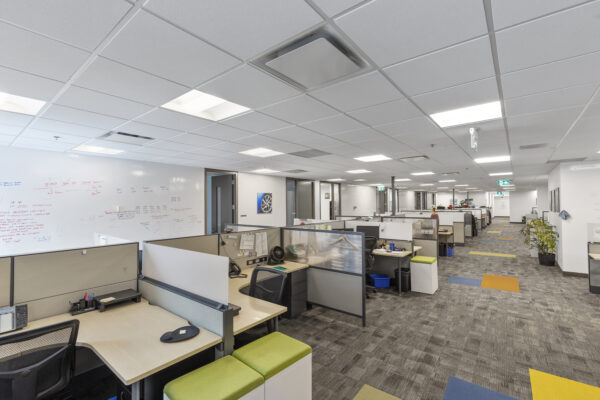
While it might seem that all employees need is a desk, a chair, a computer, and access to office supplies to be effective, the study found that a workstation that is tailored to the specific job is the most effective and improves work satisfaction. Workstation variables “such as amount of space, arrangement of furniture/equipment, storage capacity and accessibility to reference materials influence the quality of the work process, which in turn affects job satisfaction”.

Takeaways

  • Think through employee needs when designing workstations, but revisit after several months and ask employees if they have any additional needs.
  • Don’t forget that all employees are not average human size and might have different needs from one another.
    • If you’re going to spend $300 on each chair, consider offering several options at that price point.
    • Many furniture manufacturers now offer adjustable height desks.
  • Employees will most likely have a better impression of their company management if their work needs are considered.
  • If possible, produce data regarding the changes made to workstations to prove effectiveness. But, don’t forget that some things may simply have perceived value and add to employee satisfaction.

Readers: What adjustable workstation features have you found to make you more effective and your job more satisfying?

Why You Need a Commercial Realtor

by Chris Fyvie - 416-992-9869 on January 23,2012

Commercial Real Estate

Original Article – Hans Steege

We thought we’d save money by acting as our own leasing agent. That’s how we learned–the hard way–what realtors really do.

A good commercial realtor is worth his or her weight in gold.

To many of you, I may just be stating the obvious. But we learned this the hard way.

Last year my small company needed to relocate to a bigger, better space.  We knew that we would continue to lease, where we needed to be located (generally), how much space we needed, and roughly how much we could spend.

Armed with that information, we figured it would be in our interest, and in the interest of our future landlord, if we acted as our own leasing agent. We could then take the money we saved by not having a realtor and split it with our landlord. That would make us a more attractive tenant, right?

Wrong.

I guess, in a sense, forgoing a realtor did make us a more attractive tenant. When building owners realized we did not have representation, they thought they could take advantage of us. And without a realtor acting on our behalf, we were also often seen as a company that didn’t need to be taken seriously.

We didn’t know any of this in January 2010, when our quest for a new location began. We scoured online listings and drove around acceptable neighborhoods. We even called listing agents directly to see spaces, even though it’s Real Estate 101 that you should never do this. That’s how sold we were on our belief that landlords would share our enthusiasm for saving money.

We looked at many buildings. Some were good, some were bad. We did our own CAD work to figure out if a space would work. (That part of going it alone worked.) The building owners were generally happy to give us CAD data for us to work with, so there was no need for us to work with an outside architect to figure out how we could actually use the space in a prospective building.

By summer, we felt ready to offer our proposals to the finalists. We figured that any of the options would be acceptable, and that we could use each as leverage against the other.

At least, that was our plan until the first proposal was ignored. The other proposals were all replaced by the building owners’ own proposals, which bore no resemblance to what we had drawn up. We started to negotiate a lease for the space that we liked best, but after weeks of going around in circles it was clear that we weren’t getting anywhere.

So we bit the bullet and hired a commercial realtor. Thank goodness. We had done a great job of figuring out which space and location would work best for us, but the real value the realtor provided was negotiating the terms of the lease and the build-out provisions.  We didn’t get everything we wanted, but we got a lot more than we would have otherwise. We got a significant rebate to cover build-out costs, reasonable repair terms, and the ability to have dogs in the office. And, of course, the wisdom not to try this on our own next time.

News – The Reality of Toronto’s Office Market – January 2012

by Chris Fyvie - 416-992-9869 on January 23,2012

Toronto Commercial Real Estate News January 2012

In reality, the opportunity to buy a AAA asset in Toronto can come up only once a decade and there are REITS out that will stretch for the deal.

Article – Scotia Plaza is up for sale.  They are hoping to achieve $1 billion and now that the teachers have the cash to spend after selling the Leafs it may happen?
Article – Dundee REIT just closed on Whiterock for $580 million
Article – This was right on the heals of their purchase for Slate Properties at $832 million

Landmark Office Building purchase:
1) Commerce Court, Toronto (2000), $618-million
Sold by CIBC to British Columbia Investment Management Corp.

2) Royal Bank Plaza, Toronto (1999), $485-million
Sold by Royal Bank to Oxford Properties and OMERS Realty Corp.

3) Bankers Hall Complex, Calgary (2000), $437-million
Sold by TrizecHahn Corporation and Calgary Financial Tower Ltd. to Gentra Canada Investments

4) Brookfield Place – TD Canada Trust Tower, Toronto (2008), $429-million (half-stake)
Sold by Brookfield Properties to OMERS Realty

5) Gulf Canada Square, Calgary (2007), $382-million
Sold by O&Y, Brookfield, CGS to Great West Life and London Life

By the numbers:
Downtown – 4.6% vacancy rate (overall) – but most tenant’s are looking for B class space in the Financial Core which sits at 3.3%

Our numbers show the opportunities for “deals” in B class office buildings are in the Yonge and Eglinton (6% vacancy) and Yonge and St. Clair markets (7.4%).  Contrary to expectations, Yonge and Sheppard is actually one of the strongest performing markets at a vacancy rate of 1.3%!

Other thoughts:
·         Since 2000, the GTA office market has averaged 2.3 million square feet of absorption annually.  This year’s absorption hit over 4.1 million square feet, higher than the 2010 annual absorption of nearly 3.4 million square feet.

·         The Downtown office market hit a 10-year high showing positive absorption of 2.1 million square feet.  In the last 10 years, absorption has repeatedly been under 2 million square feet, with the last high being in 2000, when over 3.2 million square feet was absorbed throughout the year.

·         Availability rates in the Downtown office market have continued to decline, reaching 8.0 percent at the end of the quarter. The last time the availability rate was this low was in the fourth quarter of 2008, when it was 7.5 percent.